https://j.people.com.cn/n3/2026/0724/c95952-20481648.html
Invisible AI agents and visible traffic management robots have become integrated into the daily commutes of Shanghai residents. By controlling traffic lights at the millisecond level, predicting traffic peaks in advance, flexibly issuing warnings for traffic violations, and optimizing traffic flow across the entire road network, AI acts as an “assistant” supporting traffic management in this megacity—making travel smoother, safer, and more comfortable for everyone.
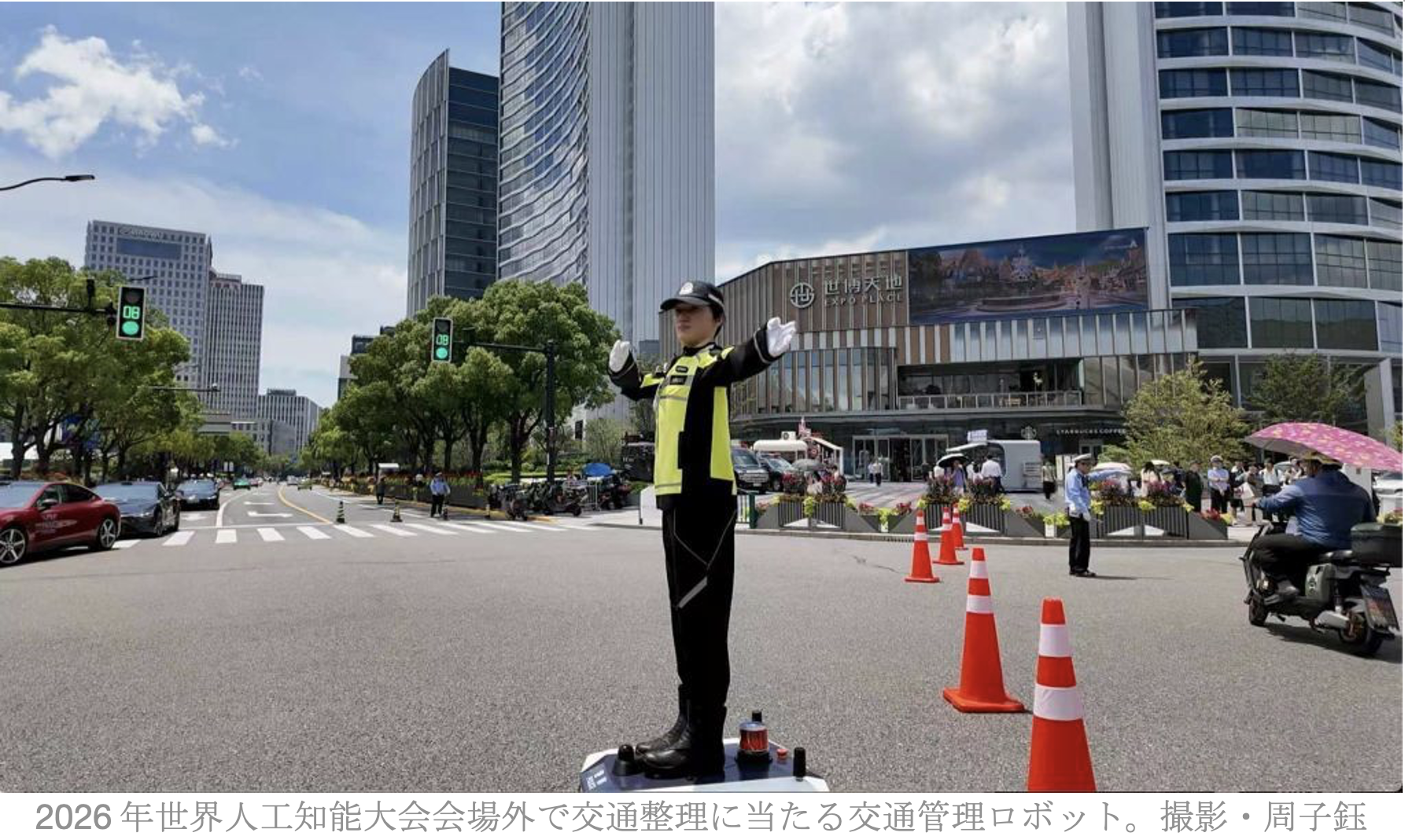
“The nearest station is the China Art Museum Station on Metro Line 8. Walk east along Bocheng Road in Pudong New Area for about three minutes to reach the entrance.” “You in the black outfit—please use the crosswalk.” During the 2026 World Artificial Intelligence Conference (WAIC), two humanoid traffic management robots stationed at intersections near the Shanghai World Expo Exhibition & Convention Center drew the attention of many citizens. These robots serve as “smart traffic assistant officers” unique to the area surrounding the event venue.
The intersection of Changhai Road and Hengren Road, located near Changhai Hospital in Yangpu District, is another spot frequently plagued by traffic congestion. AI analysis of traffic data and traffic profiles at this intersection revealed that the congestion was caused by vehicles queuing on the road while waiting to enter the hospital’s parking lot, which had reached capacity. Traffic management authorities implemented optimization measures covering 20 intersections within a 1.7-square-kilometer area, coordinating the main roads with the area as a whole. Consequently, online navigation data showed that despite a 14.9% increase in traffic volume, the average travel speed improved by 13.2%.
To date, the AI-driven traffic alleviation system has been deployed on a large scale—following a strategy of expanding from “points to lines, and then to areas”—across more than 1,200 intersections, 15 key road sections, and five core zones in Shanghai. As a result, average travel speeds in these respective categories have improved by 4.1%, 14.3%, and 12%.