https://www.cas.cn/syky/202606/t20260629_5113856.shtml
https://www.sciencedirect.com/science/article/abs/pii/S1096717626000868?via%3Dihub
L-homoserine is a non-proteinogenic amino acid used in the synthesis of various high-value-added chiral chemicals. While microbial synthesis technology for L-homoserine has advanced rapidly, most existing strains rely on plasmid-based expression systems or auxotrophic genetic backgrounds; these approaches face bottlenecks such as poor genetic stability and limitations in large-scale production, thereby hindering industrial-scale manufacturing.
A team from the CAS Institute of Microbiology constructed a new generation of engineered E. coli strain NS18—which is neither auxotrophic nor plasmid-based—for high-level L-homoserine production. This strain utilizes a low-cost inorganic salt medium for fermentation, achieving L-homoserine titers and volumetric productivities that rank among the highest reported to date.
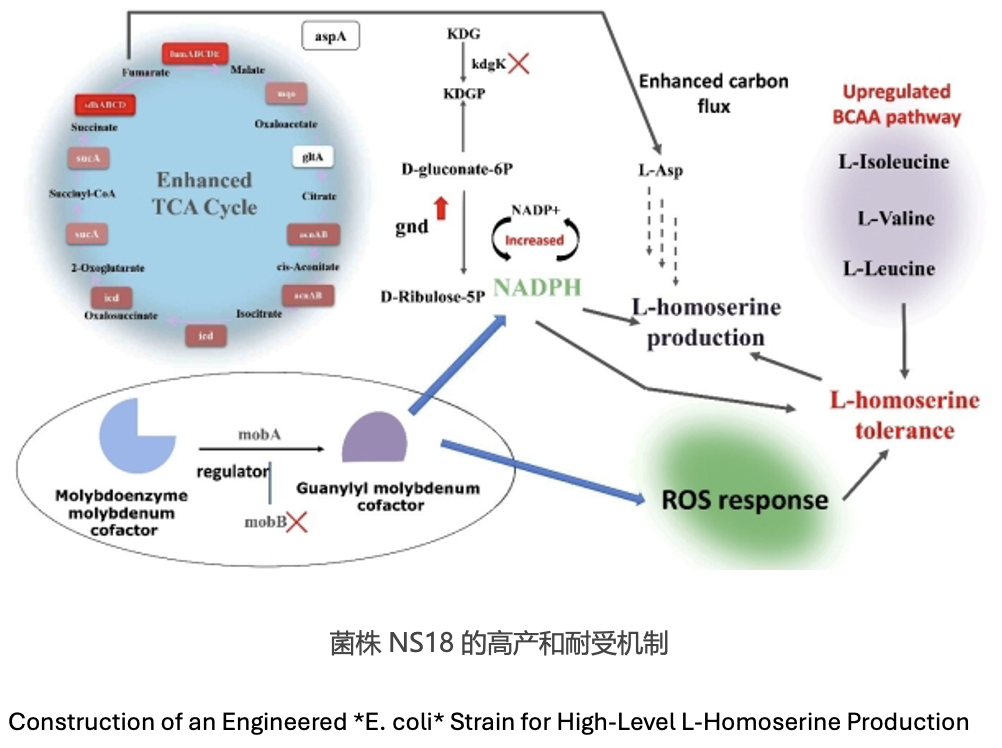
The research team employed a whole-genome mutagenesis tool combined with adaptive laboratory evolution to increase the strain’s tolerance to L-homoserine concentrations exceeding 100 g/L. Through fermentation process optimization, strain NS18 achieved an L-homoserine titer of 144.5 g/L and a yield of 0.48 g/g within 48 hours using the low-cost inorganic salt medium. By integrating comparative genomics, transcriptomics, and metabolite analysis, the team elucidated the molecular mechanisms underlying the evolved strain’s high productivity and tolerance. The results indicated that the inactivation of key genes, such as *kdgK* and *mobB*, played a pivotal role in enhancing the strain’s tolerance and production capacity. In the evolved strain NS18, the expression of key genes in the tricarboxylic acid (TCA) cycle and the pentose phosphate pathway was significantly upregulated, leading to elevated intracellular NADPH levels that provided sufficient reducing power for efficient L-homoserine synthesis. Additionally, the strain demonstrated enhanced physiological tolerance under high-concentration product stress by upregulating the branched-chain amino acid biosynthesis pathway.
This study overcame the challenge of product toxicity in L-homoserine biosynthesis and established a systematic cell factory optimization strategy combining rational design with non-rational evolution, laying a technical foundation for the industrial production of L-homoserine and its downstream products.