https://www.cas.cn/syky/202605/t20260526_5110893.shtml
https://www.sciencedirect.com/science/article/abs/pii/S0304389426012562?via%3Dihub
Aflatoxin B1 (AFB1) is a common mycotoxin found in agricultural products; consequently, the development of rapid, highly sensitive, and low-cost methods for its detection is of paramount importance for ensuring food safety. While the intrinsic fluorescence of AFB1 offers high sensitivity, its fluorescence signal undergoes significant quenching in aqueous solvents. Furthermore, co-extracted substances present in complex real-world samples often introduce background interference. For these reasons, fluorescence-based detection methods are typically employed in conjunction with high-performance liquid chromatography (HPLC) systems.
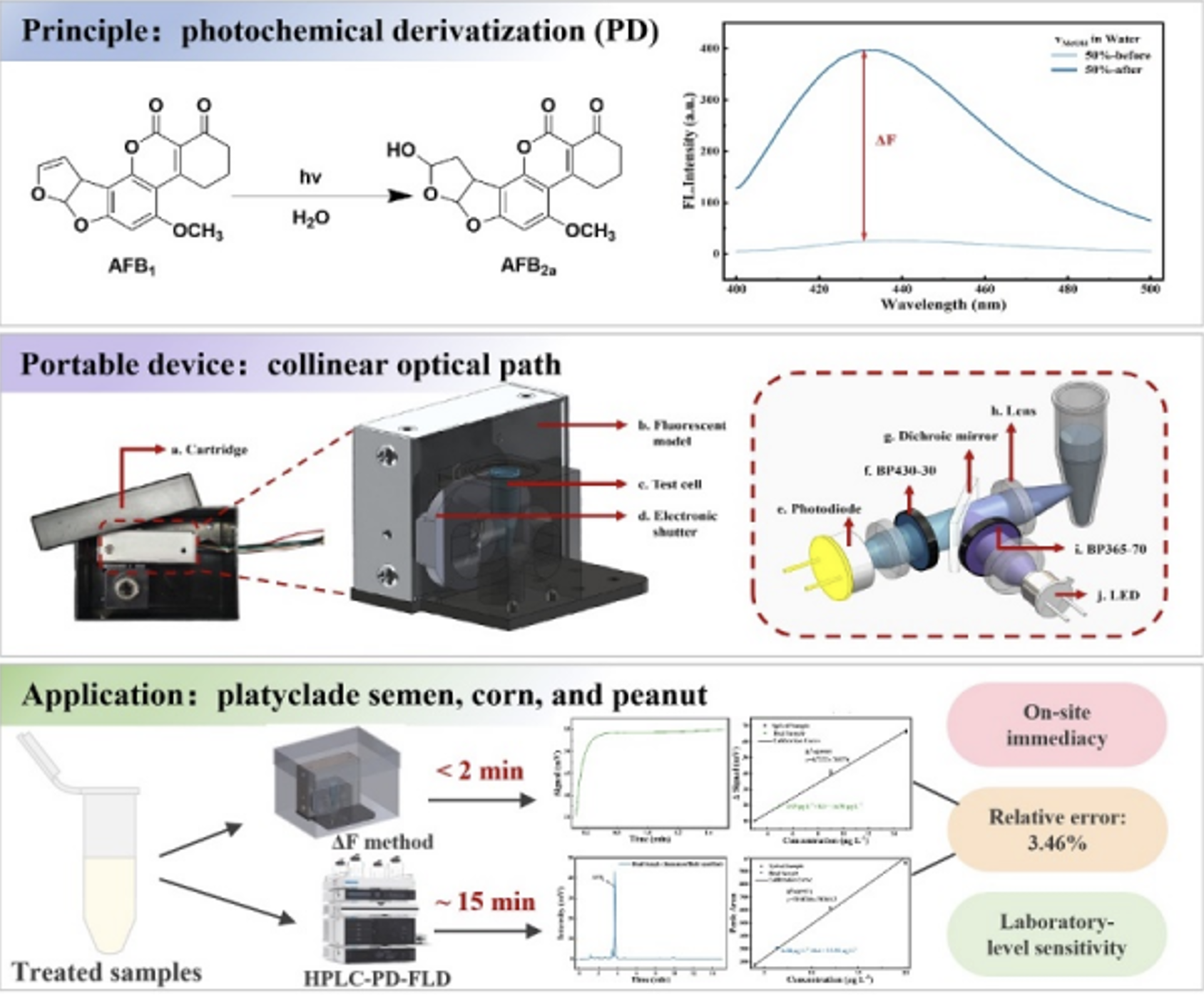
A research team at the CAS Dalian Institute of Chemical Physics (DICP) has proposed a novel strategy for *in situ* photo-derivatization-enhanced fluorescence detection. This strategy enables the rapid, highly sensitive, and highly accurate detection of AFB1 in food samples without the need for chromatographic separation. The team developed a miniaturized device that integrates both photochemical derivatization and fluorescence detection capabilities. By measuring and isolating the specific fluorescence signal increase generated by the characteristic photoreaction of AFB1, the device eliminates the majority of background fluorescence interference. This approach enables highly selective and highly sensitive identification and quantification of AFB1 within complex matrices, all without the necessity of chromatographic separation.
The developed analytical method demonstrates excellent linearity across a concentration range of 0.05 to 200 µg/L, features a detection limit of 0.024 µg/L, and requires less than two minutes per single analysis. When applied to the analysis of complex real-world food samples, the method exhibited robust reliability; the relative error compared to established national standard detection methods was a mere 3.46%, yet the total analysis time was reduced nearly tenfold.