http://english.cas.cn/newsroom/research-news/202605/t20260508_1158608.shtml
https://www.sciencedirect.com/science/article/abs/pii/S1385894726036259?via%3Dihub
Researchers from the CAS Institute of Applied Ecology have developed a fermentation process that simultaneously enhances biohydrogen production and sequesters carbon dioxide.
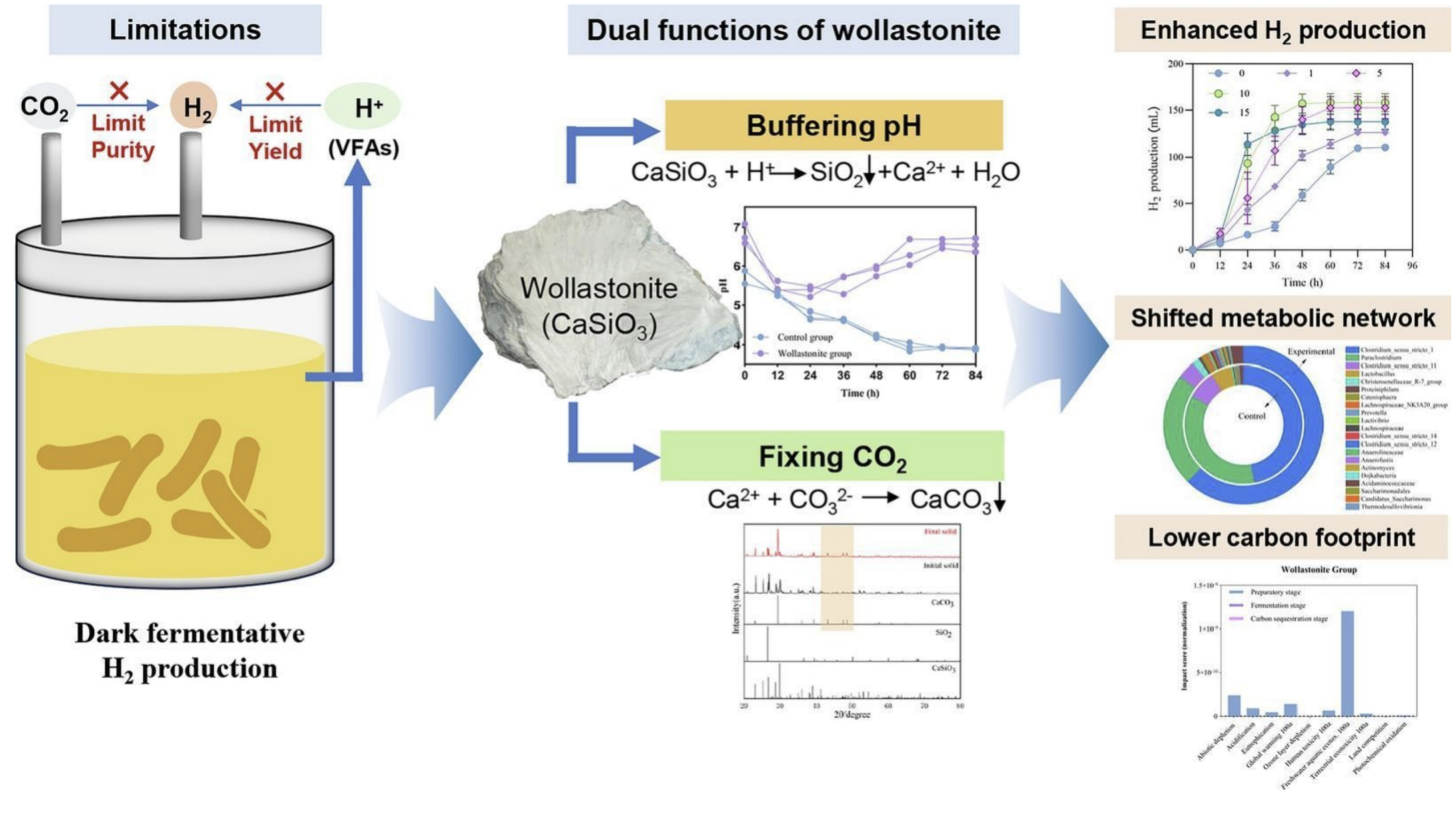
Dark fermentation produces hydrogen gas from organic substrates under oxygen-free conditions, making it a promising route toward carbon-neutral hydrogen. In practice, however, the process is often limited by the accumulation of volatile fatty acids, which decrease pH levels and suppress microbial activity.
To address these limitations, the researchers introduced wollastonite (CaSiO3), a naturally occurring silicate mineral, as a dual-function additive. As acids accumulate during fermentation, they gradually dissolve the mineral, consuming protons and releasing calcium ions. This mechanism provides continuous, self-regulating pH buffering that stabilized the system at pH 6.5–7.0.
At an optimal dosage of 10 g/L, the lag phase of hydrogen production decreased by about 50%, and the specific hydrogen yield increased by roughly 33%.
The stabilized pH environment also reshaped the metabolic landscape. Acetate production increased significantly, while lactate accumulation decreased to negligible levels. The acetate-to-butyrate ratio rose from 0.55 to 0.91, indicating a shift toward acetate-type fermentation. This pathway is more favorable for hydrogen generation.
Microbial community analysis corroborated this shift. The relative abundance of Clostridium sensu stricto 1, a key hydrogen-producing genus, increased from 47.2% to 62.4%. Meanwhile, Lactobacillus, which is associated with competing lactate production, nearly disappeared.
The researchers also found a trade-off between the two target functions. Efficient CO2 mineralization requires a neutral to slightly alkaline pH, which is achievable at higher wollastonite dosages (≥15 g/L), yet these conditions compromised hydrogen yield. To decouple the two objectives, the researchers devised a two-stage strategy: the first stage uses the optimal 10 g/L dosage to maximize hydrogen output, while the second stage applies a post-fermentation pH adjustment to 7.0 to induce carbonation.
Using this approach, the system captured 0.49 ± 0.05 liters of CO2 per liter of medium and enriched the hydrogen content of the final biogas to 58.2 ± 1.1%.
Solid-phase characterization confirmed that the captured CO2 was mineralized as calcite-phase calcium carbonate, a stable form suitable for long-term carbon storage.
A life cycle assessment validated the environmental advantages of the optimized process. Total electricity demand decreased from 59.2 to 37.4 MJ per kilogram of hydrogen produced, with lower impacts across all ten evaluated categories, including global warming potential.
These results demonstrate the feasibility of integrating green hydrogen production with in-situ carbon capture within a single biorefinery framework, offering a practical approach to achieving negative-carbon biohydrogen production.