https://en.people.cn/n3/2026/0421/c98649-20448814.html
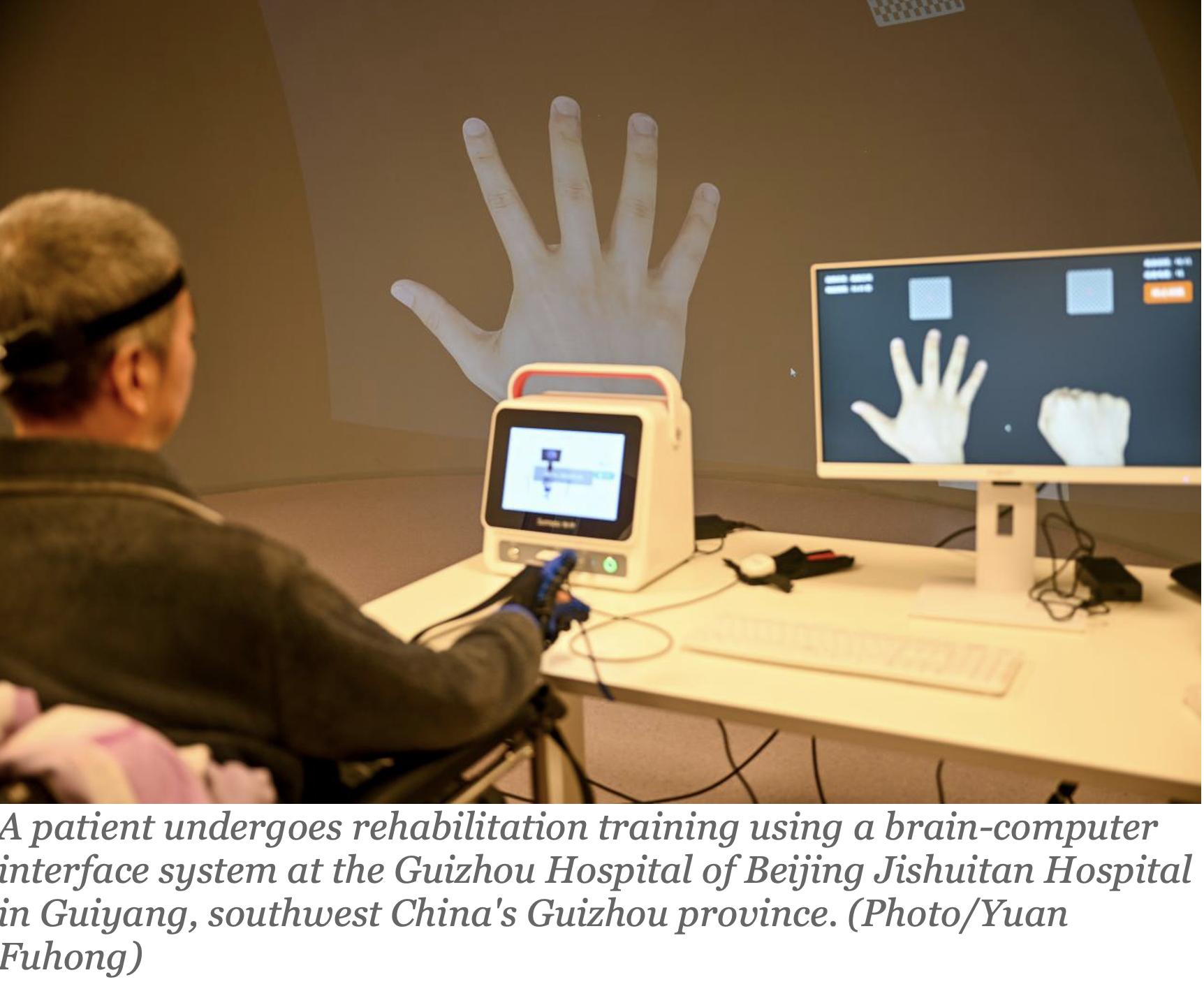
The development of innovative brain-computer interfaces are among the targets of the 15th Five Year Plan, and China’s National Medical Products Administration has recently granted the world’s first regulatory approval for an implantable BCI device.
BCI technology, first explored by scientists in the 1970s, establishes direct communication between the brain and external devices. The fundamental principle of a brain-computer interface is to establish an information pathway between the brain and external equipment that bypasses peripheral nerves or muscles. By collecting and interpreting neural electrical signals generated during brain activity and translating them into actionable commands, users are able to control external devices using nothing but their thoughts.
According to incomplete statistics, China is home to more than 3.7 million people living with spinal cord injuries, with approximately 90,000 new cases each year, underscoring the vast potential market for BCIs. China has already completed dozens of clinical procedures. Trial data show that all participating patients experienced varying degrees of improvement in grasping ability, with some even exhibiting signs of neural remodeling and partial recovery of additional neural functions.
Some institutions predict that by 2027, China’s BCI market will reach 5.58 billion yuan ($818.46 million), with an average annual growth of 20 percent. It is also widely believed in the industry that the sector is poised to enter a phase of steady growth, with medical rehabilitation serving as the primary driver while applications gradually expand into broader fields.