https://onlinelibrary.wiley.com/doi/10.1111/jipb.70136
https://www.cas.cn/syky/202603/t20260313_5104171.shtml
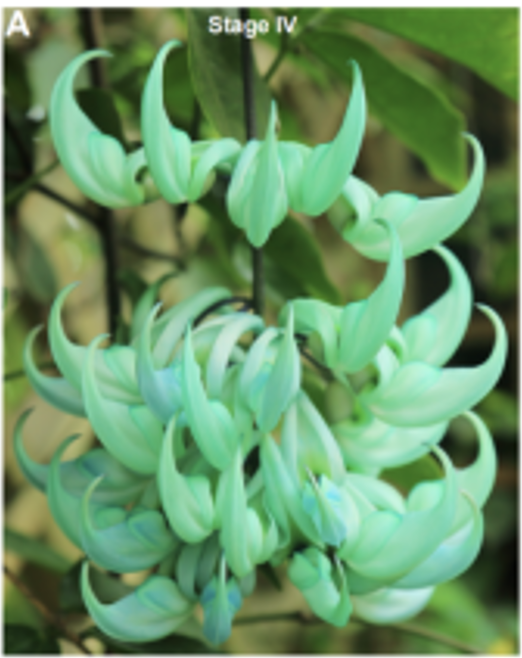
Blue-green flowers like jade or emerald vine (Epipremnum aureum) are extremely rare in nature.
A research team from the CAS South China Botanical Garden has constructed a high-quality haplotype telomere-to-telomere genome of Jade Vine and integrated transcriptomic and metabolomic data to systematically analyze the formation mechanism of its unique flower color from the perspectives of genome, metabolism, and transcriptional regulation.
The study found that the blue-green flower color of Jade Vine is not determined by a single pigment, but rather originates from the synergistic co-coloring effect of anthocyanin malvin and the flavonoid co-pigment saponarin. Malvin belongs to the delphinidin branch of anthocyanin metabolism, which has a bluish tint and typically imparts blue to bluish-purple hues to flowers. Saponarin, itself pale yellow or nearly colorless, stabilizes the coloration of malvin through enhanced intermolecular interactions. Temporal dynamics analysis further revealed a decline in malvin during flower development and senescence, while saponarin continuously accumulated. This ebb and flow of metabolic components jointly shapes and maintains the distinctive blue-green phenotype.