https://en.people.cn/n3/2026/0325/c90000-20439733.html
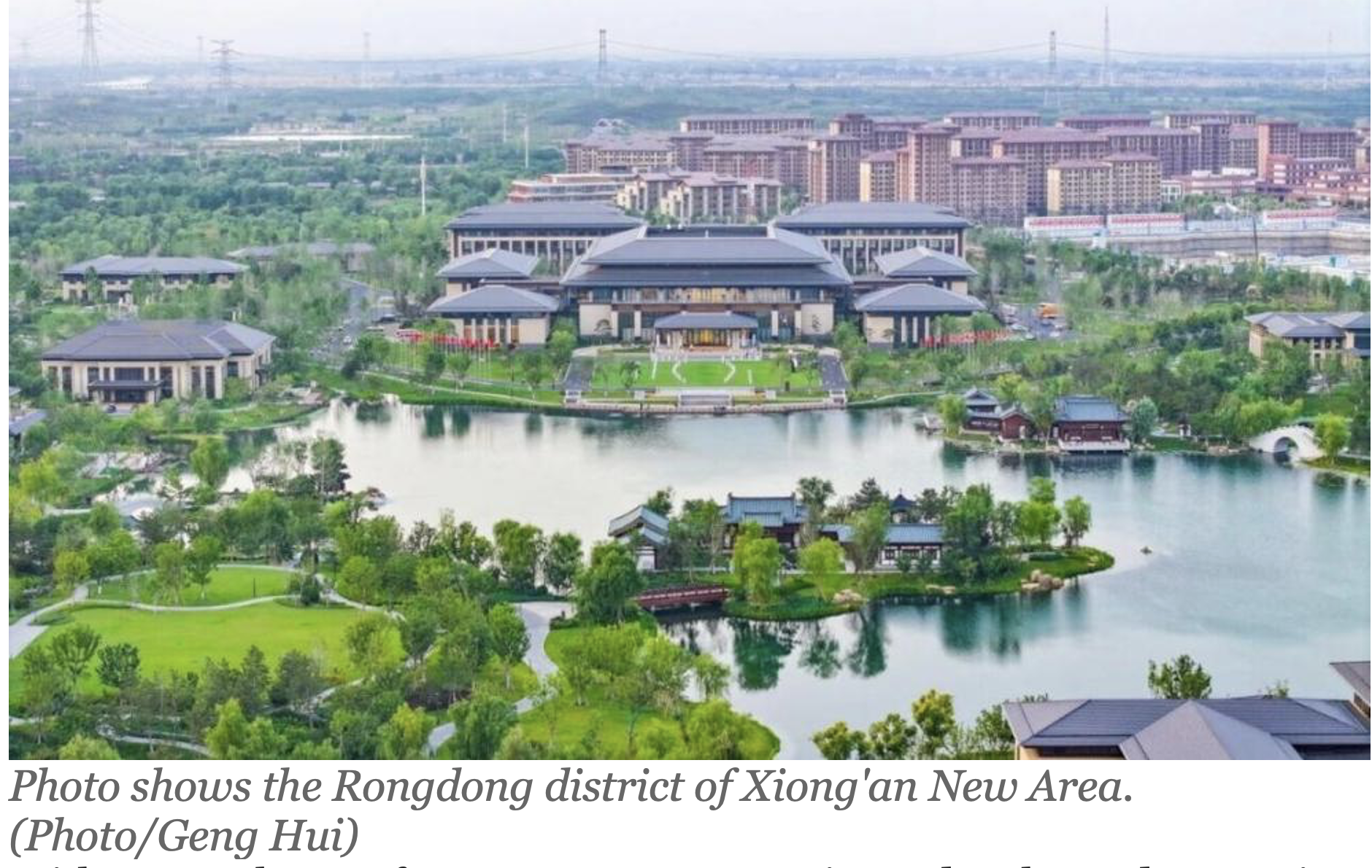
Located in the western part of the Rongdong district of Xiong’an New Area, north China’s Hebei province, the Xiong’an Urban Computing Center adopts an integrated computing system that includes edge computing, cloud computing, supercomputing, and intelligent computing, providing computing, storage, and network services for big data, blockchain, and the Internet of Things across the city,” said Zhao Song, an engineer at the center.
With 50 petabytes of current storage capacity and a planned expansion to 1,000 petabytes, the facility prioritizes sustainability. Its design includes over 10,000 square meters of ultra-low energy consumption building space, setting national benchmarks for green infrastructure. Critically, all technologies — from chips and servers to cloud platforms and applications — are domestically developed.
All government service systems in Xiong’an New Area are hosted at the computing center. Enterprises such as China Satellite Network Group Co., Ltd., China Space-Time Information Co., Ltd., and China Xiong’an Group, along with research institutions including the Institute of Computing Technology of the Chinese Academy of Sciences and the Xiong’an Institute of Meteorological Artificial Intelligence, have also deployed their operations here. To date, the center has aggregated over 38 billion data entries and handled more than 400 million shared interface calls.
As a “city of the future” entrusted with a mission of lasting national significance, Xiong’an integrates intelligence and innovation into its development, with the digital city and the physical city evolving in tandem.
In Xiong’an, even traffic lights can “think.” During morning rush hour in the Rongdong district, traffic signals adjust in real time based on traffic flow — an example of the city’s artificial intelligence-powered system and a vivid illustration of its digital twin model.
Underground utility tunnels also reflect this digital intelligence. Through digital twin technology, sensor devices, and building information modeling, early warnings for potential issues in water, electricity, gas, heating, and communication systems are monitored. In Xiong’an, every building, road, and pipeline has its own “digital ID.” “The digital city enables more precise and efficient urban governance,” Zhao added.
Xiong’an New Area has established a smart city standards system based on building information modeling and city information modeling platforms. It has built an independently innovative urban computing system featuring coordinated edge-cloud supercomputing integration, while achieving full coverage of IPv6, the HarmonyOS ecosystem, and sensing systems. Smart applications from government services and environmental protection to transportation and energy, are being rapidly implemented across the city.