https://j.people.com.cn/n3/2026/0318/c94638-20437355-5.html
http://bj.people.com.cn/BIG5/n2/2026/0319/c14540-41527898.html
The Embodied Intelligence Tactile and Multimodal Perception Data Training Innovation Center in Beijing’s Shijingshan District is like a “professional vocational school” for robots. In highly realistic spaces such as kitchens, living rooms, and convenience stores, robots are repeatedly practicing fine motor skills such as grasping water bottles, folding clothes, and sorting parts under the guidance of real “teachers.” This seemingly ordinary scene contains the key force driving artificial intelligence into the physical world.
Traditional humanoid robots only possess basic abilities like walking and simple movements when they leave the factory, like ‘elementary school students’ just starting school. The center’s core work is to create a professional skills training system for these robots.
- Tashan Technology has developed AI tactile perception technology, equipping robots with sensitive “electronic skin.” On a demonstration device, it can be observed that even before a finger touched the sensor surface, the sensor could detect subtle pressure changes and respond quickly. This technology, applied to the robot’s fingertips, allows it to accurately sense the force required to grasp objects, making it adept at picking fragile fruits like blueberries or removing soft packaging. This is the core of the third phase of the project—focusing on high-precision tactile sensing data acquisition, filling the gap in the previously limited precision of robot operations.
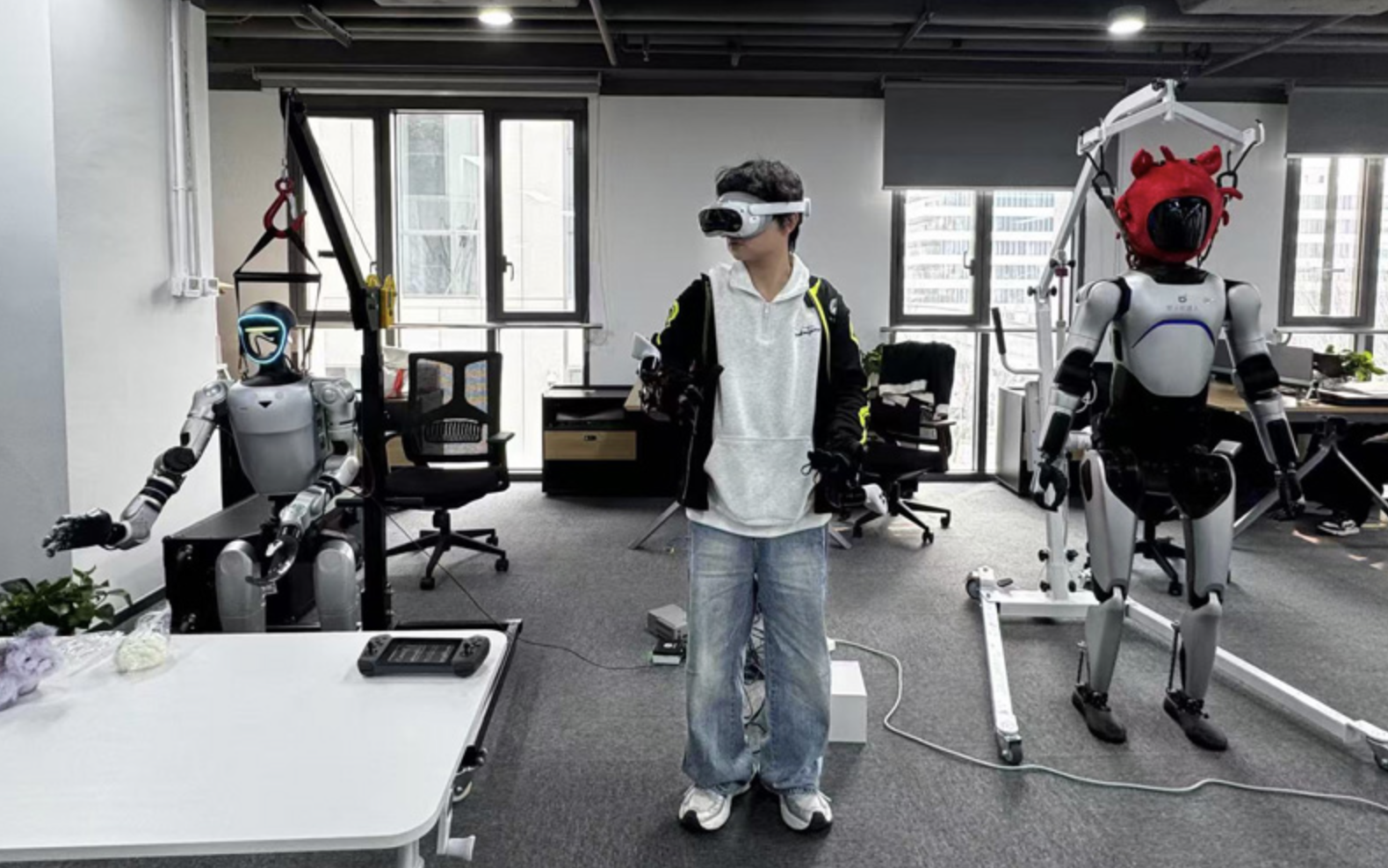
- At Lingyu Technology (Beijing) Co., Ltd., several staff members wearing AR glasses performed grasping actions in virtual space. Traditional data collection requires building real-world scenarios and equipping physical robots, which is costly. Here, a virtual-real fusion collection solution is adopted, building scenarios within a simulated physics engine. Operators wearing VR devices can control virtual robots to complete tasks, significantly reducing enterprise R&D and testing costs and improving model training efficiency.