https://en.people.cn/n3/2026/0320/c90000-20438370.html
https://www.cas.cn/syky/202603/t20260320_5104712.shtml
https://www.science.org/doi/10.1126/science.adv2188
The rice we eat (cultivated rice) is an annual, but its ancestor—common wild rice—was a perennial, creeping “weed.” How wild rice gradually transformed into annual cultivated rice during the domestication process has long been a mystery.
Recently, a team from the CAS Center for Excellence in Molecular Plant Sciences cloned for the first time the “longevity gene” EBT1, which determines the perennial lifestyle of wild rice, and discovered that it is a change in the expression pattern of this gene locus that caused rice to change from a perennial to an annual.
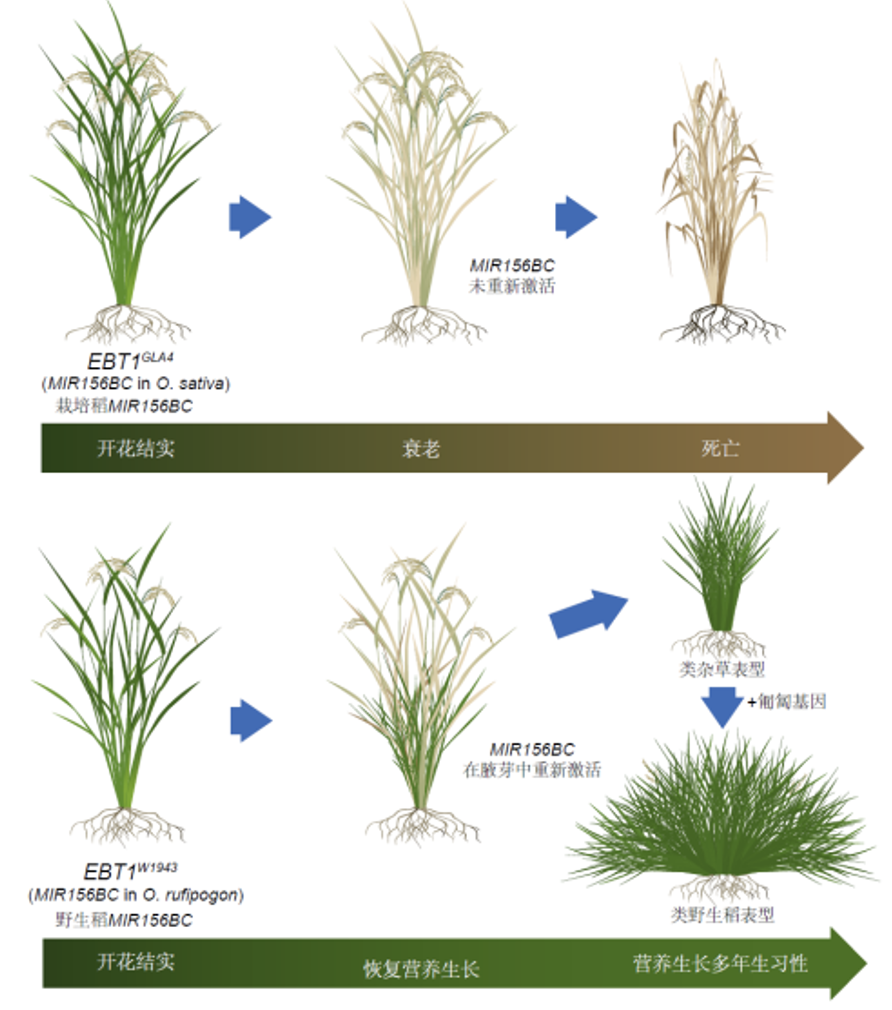
The team observed 446 wild rice samples and found that, unlike annual cultivated rice, some wild rice plants do not wither and die after seed maturation. Instead, new lateral branches continuously sprout from the stem nodes. These branches take root and develop into new plants. This is a phenomenon known as “flowering reversal,” which, simply put, means that after wild rice flowers and fruits, it reverts to a vegetative growth state, achieving asexual reproduction and perennial growth.
To find the key gene controlling the perennial nature of rice, the team crossed perennial Dongxiang wild rice with annual indica rice to construct a chromosome substitution line. Then, using fine map-based cloning technology, they finally located and cloned EBT1. This gene locus consists of two microRNA genes, MIR156B and MIR156C.
miR156 is considered the “age switch” in plants. Traditionally, it is thought to be highly expressed in seedlings and gradually decrease as the plant matures, prompting it to transition from leaf growth to flowering and fruiting. However, the new research found that MIR156B and MIR156C in wild rice are reactivated after flowering, causing axillary buds to reverse development, resume growth, and continuously produce new branches, achieving asexual reproduction. This unique phenomenon is closely related to the epigenetic modification state of the EBT1 gene locus in wild rice.
Further research revealed that this gene underwent artificial selection during rice domestication. In pursuing high yields and compact plant types, researchers may have inadvertently “discarded” the perennial genes of wild rice.
Notably, researchers successfully bred a “wild rice-like” plant by combining EBT1 with two known rice creeping genes, replicating the wild rice weed phenotype. This rice exhibits strong asexual reproduction capabilities and can survive for at least two years in Hainan fields.
This research not only deepens our understanding of the evolution of plant life history strategies but also provides important theoretical basis and genetic resources for the perennial biochemical improvement of rice varieties and the breeding of ratooning rice.
Graph: MIR156BC Reset Mediates the Transition of Rice from Annual to Vegetative Perennial.