http://english.cas.cn/newsroom/research-news/202603/t20260303_1151401.shtml
https://doi.org/10.1631/bdm.2500276
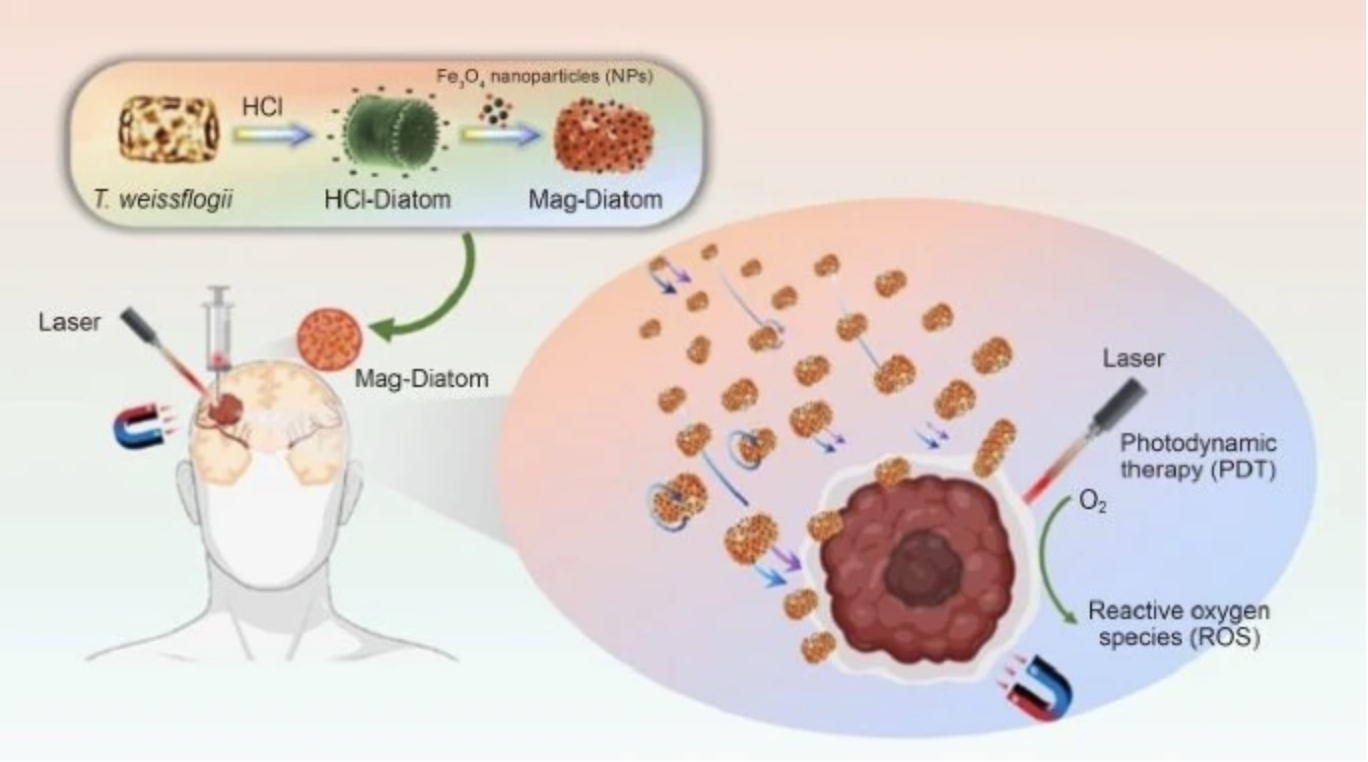
A research team from the CAS Shenyang Institute of Automation (SIA), in collaboration with Shengjing Hospital of China Medical University, has developed magnetically controlled microrobots made from diatoms for the treatment of glioblastoma using photodynamic therapy. These microrobots exhibit excellent magnetic responsiveness and programmable motion capabilities, enabling them to precisely target and navigate to glioblastoma lesion areas. Once positioned at the tumor site, the diatom-based microrobots can be activated by laser irradiation, triggering a photodynamic therapeutic effect. The researchers utilized the endogenous chlorophyll inherent in the diatoms as a natural photosensitizer, achieving photodynamic therapy (PDT) against glioblastoma without the need for additional drug modification or loading.
To construct the microrobots, the researchers used acid treatment techniques to process the diatoms into micro- and nanoscale robotic platforms. The intrinsic porous architecture of the frustule enables potential drug loading, while an external magnetic field is employed to control their movement, making them suitable for precise drug delivery. During fabrication, the natural chlorophyll contained within the diatom cells was deliberately preserved to function as a natural “drug.”
Using artificial intelligence algorithms, the diatom robots achieved autonomous closed-loop motion control, enabling navigation along preset trajectories. The robots also demonstrated the ability to traverse narrow gaps and target cancer cells within cellular environments.
In animal experiments, the researchers injected the diatom microrobots directly into intracranial glioblastoma lesions in mice and activated photodynamic therapy using laser irradiation. The treatment reduced the survival rate of primary glioblastoma cells to 19.5%. Further results confirmed that the microrobots effectively inhibited tumor growth without causing significant systemic toxicity.