https://www.cas.cn/syky/202601/t20260123_5097030.shtml
https://iopscience.iop.org/article/10.3847/1538-3881/ae2ea6
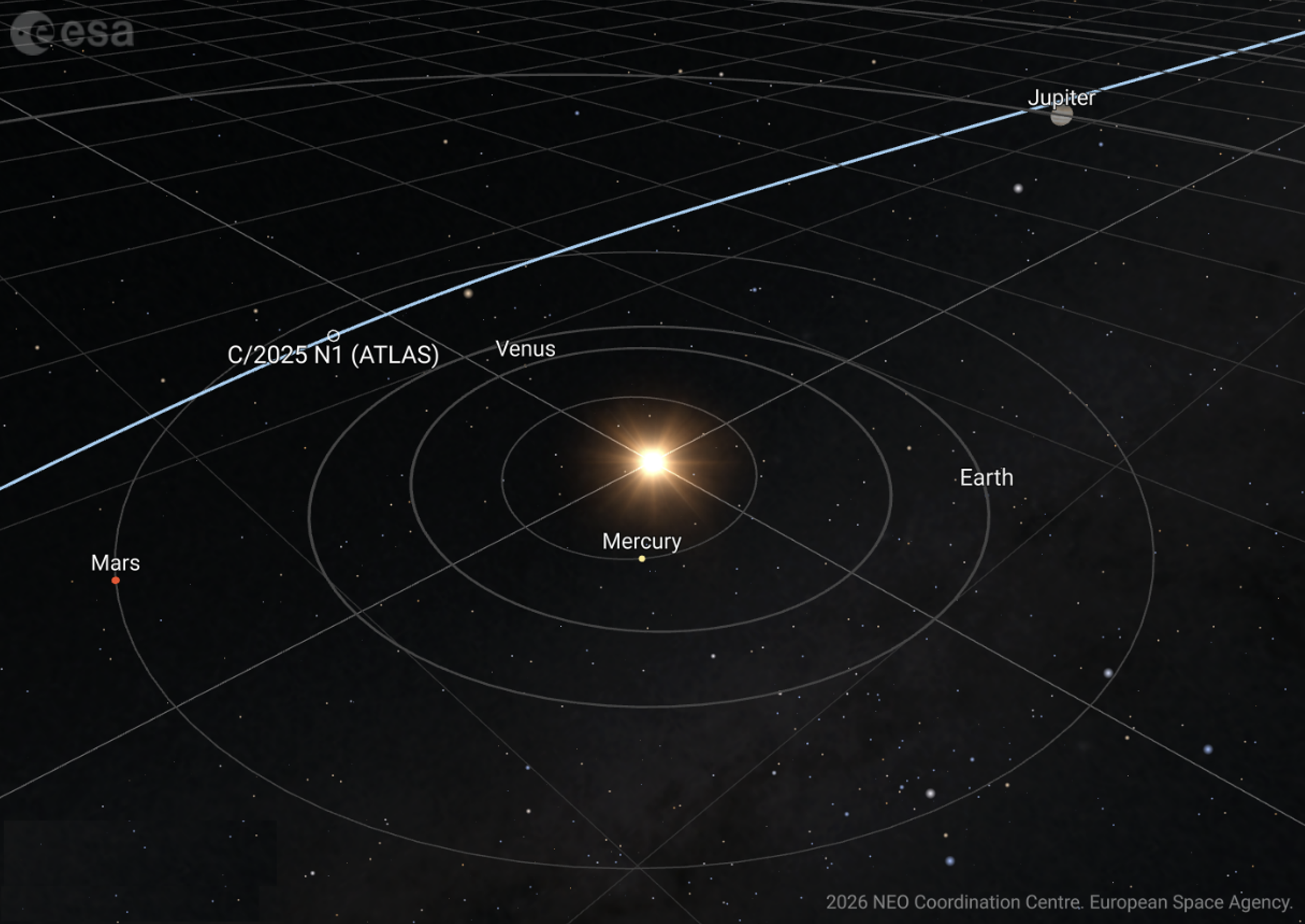
An international research team led by the Shanghai Astronomical Observatory of the Chinese Academy of Sciences, through high-precision numerical simulations, has investigated the planetary dynamics and potential collision probabilities between Comet 3I/ATLAS and the planets of the solar system. Following ‘Oumuamua and ‘Borisov,’ Comet 3I/ATLAS is its third confirmed interstellar visitor.
Its orbital inclination is approximately 175°, meaning its direction of travel is almost opposite to that of most objects in the solar system. More importantly, its perihelion distance is only about 1.36 AU, meaning it will be “going against the current” through the densely packed region of the inner solar system. This unique orbital characteristic raises a crucial scientific question: what dynamic interactions will occur when Comet 3I/ATLAS encounters the tens of thousands of asteroids in the solar system? What is the probability of a collision?
To answer these questions, the research team conducted a systematic study of Comet 3I/ATLAS, focusing on the critical period from August 1, 2025 to April 1, 2026, during its transit through the inner solar system. The team used N-body numerical simulations to precisely track the comet’s path. The orbital calculations required comprehensive consideration of the gravitational influences of the Sun, the eight planets, and numerous asteroids, making the work far more complex than previous similar studies.
The research team sifted through orbital data from over 38,000 near-Earth asteroids and 1.4 million main-belt asteroids, identifying celestial bodies that could potentially come into close proximity to Comet 3I/ATLAS. Through extensive data calculations and simulations, the team concluded that during Comet 3I/ATLAS’s retrograde passage through the inner solar system, a total of 31 near-Earth asteroids and 736 main-belt asteroids would come within 0.03 astronomical units (approximately 4.5 million kilometers) of this “interstellar visitor.”
4.5 million kilometers is a mere fraction of a distance in the vast universe, only about 10 times the distance between the Earth and the Moon. On an astronomical scale, this is an extremely close proximity, requiring close attention. The encounter between Comet 3I/ATLAS and asteroid 2020 BG107 is particularly noteworthy. Through 100,000 computer simulations, the team discovered that, considering the orbital uncertainties of the asteroid, the probability of it colliding with the core of Comet 3I/ATLAS is approximately 0.025%. However, because Comet 3I/ATLAS is an active comet with a massive dust coma, the probability of the asteroid entering the coma’s range is as high as 2.7%. If this were to occur, it would be a natural “hypervelocity collision experiment.”