https://www.cas.cn/cm/202602/t20260210_5100251.shtml
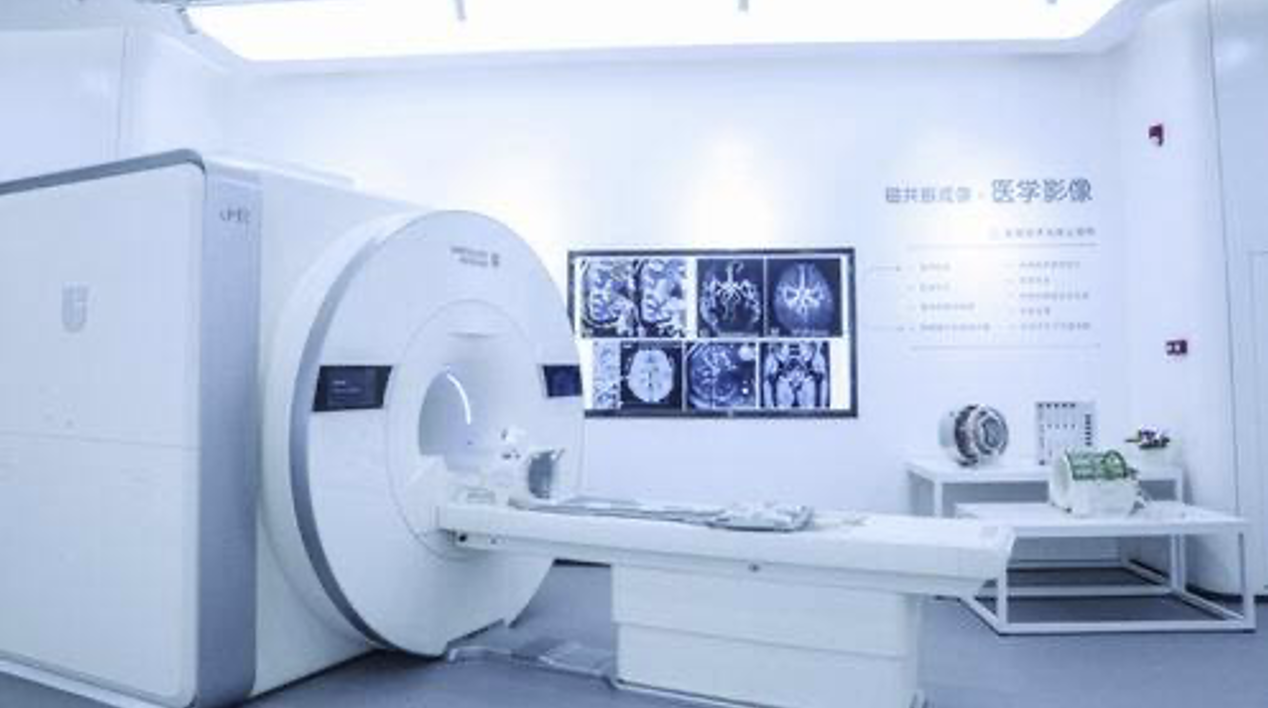
During the 14th Five-Year Plan period, the Shenzhen Institutes of Advanced Technology (SIAT) of the Chinese Academy of Sciences, in collaboration with Shanghai United Imaging Healthcare Co., Ltd. (United Imaging Healthcare), developed the world’s first 5.0T MRI, which was approved for market launch, filling the gap in human ultra-high field whole-body MRI technology that had persisted for more than 20 years internationally. Currently, the domestically produced 5.0T MRI has been installed in many hospitals and institutions across the country.
To create China’s own MRI machine, SIAT and United Imaging Healthcare had formed a joint research and development team. After years of dedicated research, they developing China’s first 3.0T MRI scanner. For over 20 years, 3.0T has been the upper limit of field strength for whole-body magnetic resonance imaging (MRI) in the international community. Higher field strength MRI had faced serious problems such as artifacts from short-wavelength radio frequency dielectric effects and thermal deposition, hindering its clinical application. Therefore, with the support of major projects from the Chinese Academy of Sciences and the Ministry of Science and Technology, the research team pioneered the use of 5.0T MRI as a breakthrough point for clinical ultra-high field MRI equipment. Its core components and technologies were all independently developed, and many indicators reached international advanced levels.
Compared to the domestically produced 3.0T MRI scanner, the 5.0T MRI scanner has achieved breakthroughs in technical indicators such as resolution, speed, and imaging field of view, enabling lesions to be “seen more clearly, scanned faster, and diagnosed more accurately.” Furthermore, the research team has pioneered a new clinical diagnostic model for ultra-high-field MRI in brain diseases, the heart, and small tumors in the body, constructing the world’s first clinical application system for ultra-high-field whole-body MRI.
Recently, the Shenzhen Institutes of Advanced Technology (SIAT) and United Imaging Healthcare jointly launched the world’s first “camera” MRI machine. This device incorporates the team’s pioneering LIVE Imaging technology, transforming the MRI machine into a “camera,” turning previously static MRI images into dynamic images that reflect the true movement of tissues and organs throughout the body. Currently, the device has received approval from the National Medical Products Administration (NMPA), as well as certifications from the U.S. Food and Drug Administration (FDA) and the European CE marking, and will be available globally.
In addition to MRI, SIAT’s Lauterbur Biomedical Imaging Laboratory also displays cutting-edge high-end medical imaging equipment—the world’s first ultrasound deep brain stimulation and neuromodulation instrument, China’s first high-definition magnetically compatible brain PET functional imaging system, China’s first large-field-of-view high-resolution small animal micro-CT, and China’s first full-field-of-view dental CT scanner, among others.
Behind these “firsts” is a multidisciplinary team with an average age of 36.9 years. They integrate their personal ideals into national strategy, continuously scaling the heights of science and technology. Currently, the Shenzhen Institutes of Advanced Technology’s biomedical imaging team has grown into a research force of over 500 people. Focusing on magnetic resonance imaging (MRI) technology development, they have accumulated over 400 intellectual property rights and published over 200 related academic papers.