https://j.people.com.cn/n3/2026/0130/c94476-20421232.html
https://en.people.cn/n3/2026/0210/c90000-20424379.html
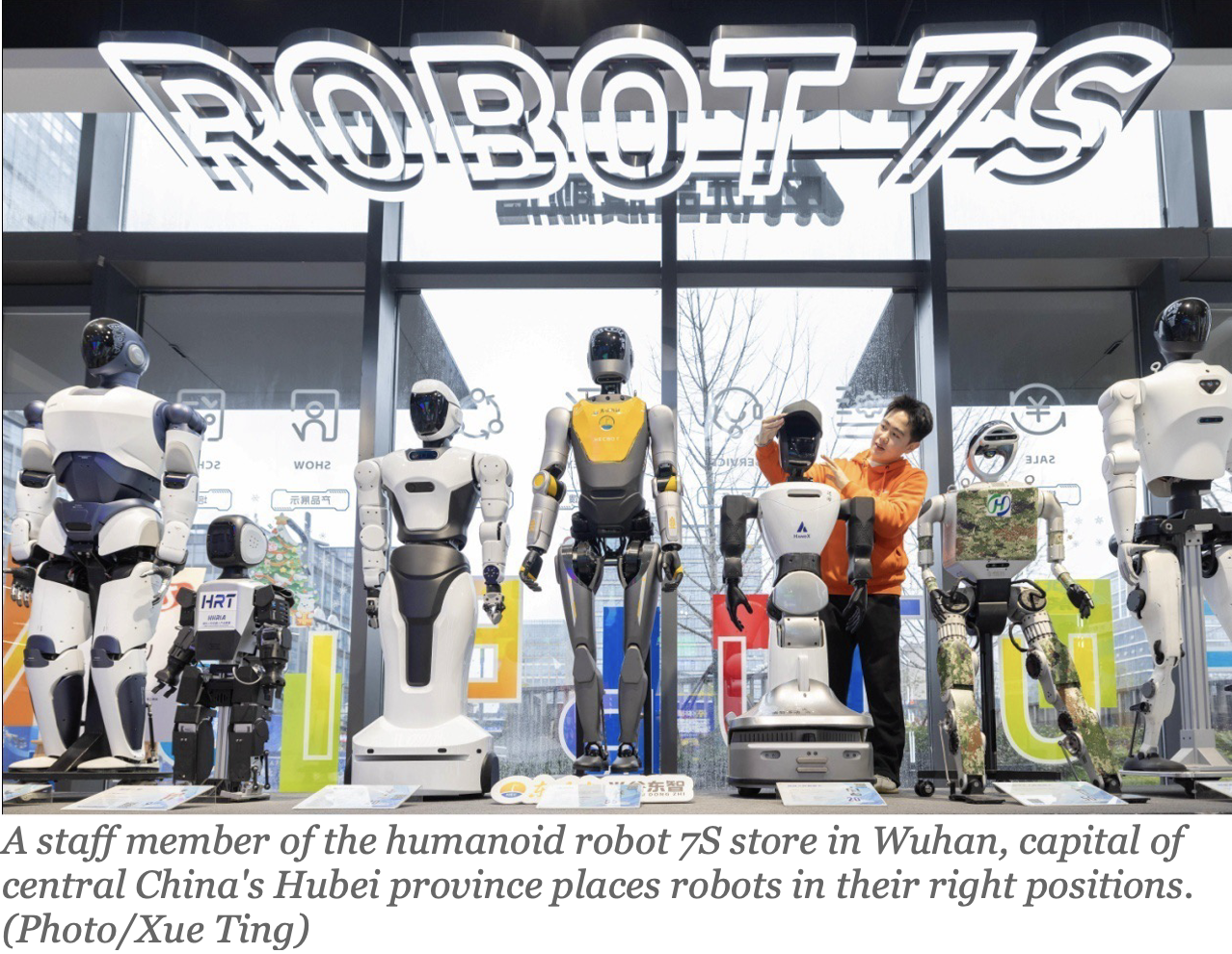
In Wuhan, Hubei Province, a “Humanoid Robot 7S Store” has opened.
It offers 17 types of humanoid robots, ranging in price from 7,999 ¥ to 700,000 ¥ (approximately 1000 – 100000 €) . They can be used in more than 10 different applications, including industrial manufacturing, cultural tourism guides, and healthcare and nursing care. The Humanoid Robot 7S Store not only provides services such as sales, parts supply, after-sales service, and information feedback, but also offers solutions, exhibitions, and training, covering a total of seven functions. It cover almost the entire industrial chain, from humanoid robot parts to finished products and practical applications.
Humanoid robots need to be used effectively. In June 2025, Hubei Province established a Humanoid Robot Innovation Center, which will serve as a “school” for humanoid robots. Newly developed humanoid robots will learn skills under the “guidance” of staff. To enable humanoid robots to learn and create real value, Wuhan City has put forward a three-year action plan for the humanoid robot industry, along with related policies and measures, to encourage the development of a variety of application scenarios. According to Dong Danhong, director of the Wuhan Municipal Science and Technology Innovation Bureau, the city will focus on promoting applications in areas involving dangerous work, manufacturing industries such as automobiles, and industries related to civilian life such as healthcare and education, so that humanoid robots can take on tasks that humans cannot do, that require a high level of standardization, and that require long working hours.
Currently, the 7S Store’s sales revenue from experience services, sales, tours, robot leasing, and other services exceeds 600,000 yuan. It is backed by the province’s flourishing humanoid robot industrial ecosystem. While there are currently limits to what humanoid robots can do, in the future they will undoubtedly be able to benefit ordinary households and provide services to all industries, supporting our lives.
According to the Ministry of Industry and Information Technology, China had more than 140 humanoid-robot manufacturers and over 330 humanoid-robot models by 2025.