https://www.nature.com/articles/s41586-025-10030-0
http://english.cas.cn/newsroom/research_news/earth/202601/t20260128_1147567.shtml
A team from the CAS Nanjing Institute of Geology and Palaeontology has discovered the Huayuan Biota, a Cambrian soft-bodied fossil assemblage dating back approximately 512 million years, immediately following the Sinsker event. This discovery fills a gap in the availability of apex soft-bodied fossils from the Cambrian Phase IV, providing crucial evidence for understanding the scale and impact of the first mass extinction event in the Phanerozoic Eon.
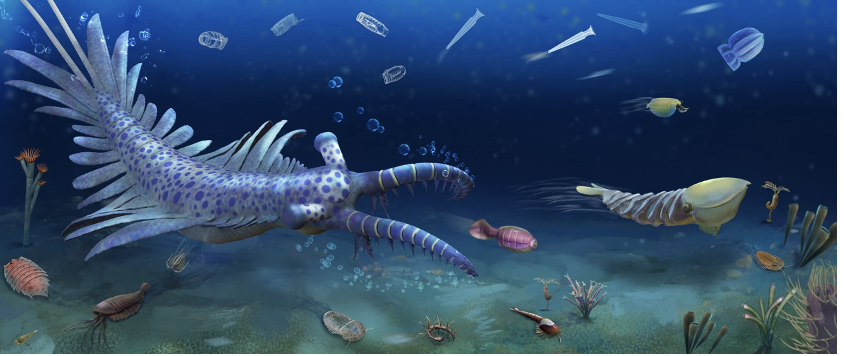
The Huayuan Biota was discovered in Mozi Village, Hunan Province. In 2020, the construction of a farm road exposed a fresh stratigraphic section of the Cambrian Palang Formation, characterized by mudstone and shale, laying the groundwork for the discovery of the Huayuan Biota fossils. The Huayuan Biota is rich in fossils, highly diverse, and exquisitely preserved. The research team has collected over 50,000 fossil specimens from this biota, identifying 153 animal species, 59% of which are new species.
The Huayuan Biota exhibits a deep-sea animal community with a complex ecosystem. The research team confirmed that this biota is a Cambrian-era organism living in a deep-sea environment on the outer continental shelf, exhibiting diverse lifestyles. Several species of tunicate planktonic tunicates were also discovered in this biota, indicating the existence of biogenic carbon pumps similar to those in modern oceans during the early Cambrian marine carbon cycle.
The Huayuan Biota reflects the differential impact of the first mass extinction event of the Phanerozoic Eon on shallow and deep-sea environments. The study shows that the Sinssk extinction event had a significant impact on shallow-water soft-bodied biota, but a limited impact on deep-sea biota, which corresponds to the widespread anoxic environment in shallow seas during the Sinssk extinction event. Meanwhile, this biota demonstrates that marine animals underwent long-distance transoceanic dispersal after the first mass extinction event of the Phanerozoic Eon. The discovery of the Kunming Guanshan shrimp within this biota confirms that the geographical distribution of a single Anomalocaris species could span 750 kilometers, thus revealing the mechanisms of long-distance transoceanic dispersal for Cambrian marine animals during this period.