https://en.people.cn/n3/2026/0123/c90000-20417990.html
https://www.science.org/doi/10.1126/science.aeb7280
https://www.cas.cn/syky/202601/t20260123_5097060.shtml
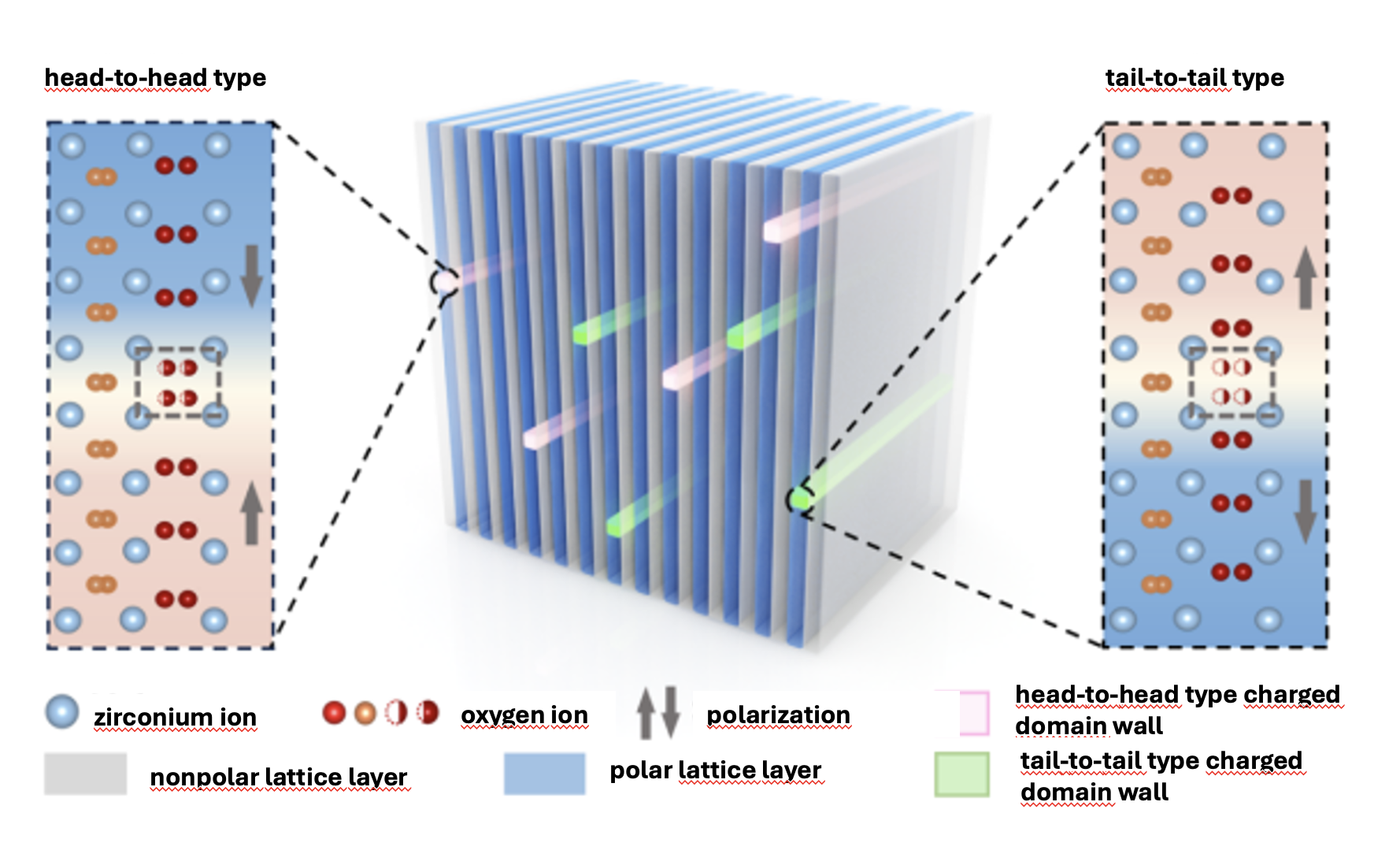
Researchers from the CAS Institute of Physics have made a breakthrough in ferroelectric materials that promises to increase information storage density. The research team identified one-dimensional charged domain walls within a fluorite-structured ferroelectric material, zirconium dioxide. Thin films of this material exhibit one-dimensional charged domain walls (1D CDWs) with head-to-head and tail-to-tail polarization. These 5-nanometer films in an alternating arrangement of nonpolar and polar oxygen ions formed 2D polar sheets that confined the 1D CDWs. Electric-field manipulation of these domain walls led to transport of oxygen ions.
Ferroelectric materials are pivotal for future technologies in fields such as data storage, sensing and artificial intelligence. Storing information within these one-dimensional domain walls could result in a several hundredfold boost of storage density.
The theoretical limit is estimated at about 20 terabytes per square centimeter, which is enough capacity to store 10,000 high-definition movies or 200,000 high-definition short videos on a device no larger than a postage stamp.