https://regional.chinadaily.com.cn/wic/2026-01/21/c_1155848.htm
https://www.sciencedirect.com/science/article/abs/pii/S0168169925014358?via%3Dihub
https://aii.caas.cn/xwdt/zhdt/1e40a75a9e564e0b8f0eed0ff51e5d86.htm
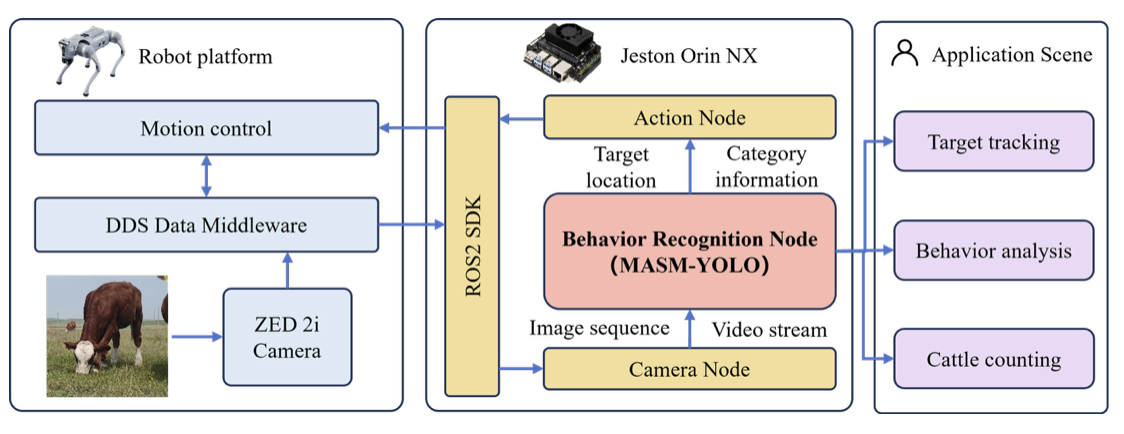
The Institute of Agricultural Information at the Chinese Academy of Agricultural Sciences developed a lightweight model, “MASM-YOLO,” for identifying beef cattle behavior using next-generation information technology. It is capable of quickly and accurately identifying six typical behaviors of beef cattle, improving the efficiency of cattle husbandry management:
- standing,
- lying down,
- eating,
- drinking,
- licking and
- suckling
Is said to provide an important foundation for disease diagnosis, estrus monitoring, calving prediction and health assessment in free-grazing environments. The model itself is also very “lightweight” and can be run directly on the computing platform installed in a four-legged grazing robot, with almost no impact on the robot’s normal operations.
Unlike barn-raised environments, the grazing environment on natural grasslands presents numerous challenges, including changing lighting conditions, complex backgrounds, occlusions between cattle, and blurring due to movement. This demands higher machine vision recognition capabilities. In the process of developing a quadrupedal grazing robot, the research team discovered that conventional object detection and behavior recognition models struggle to achieve both high accuracy and real-time performance, making them difficult to operate stably on mobile devices.