https://www.nature.com/articles/s41586-025-10013-1
https://en.people.cn/n3/2026/0122/c90000-20417412.html
https://www.cas.cn/cm/202601/t20260123_5097040.shtml
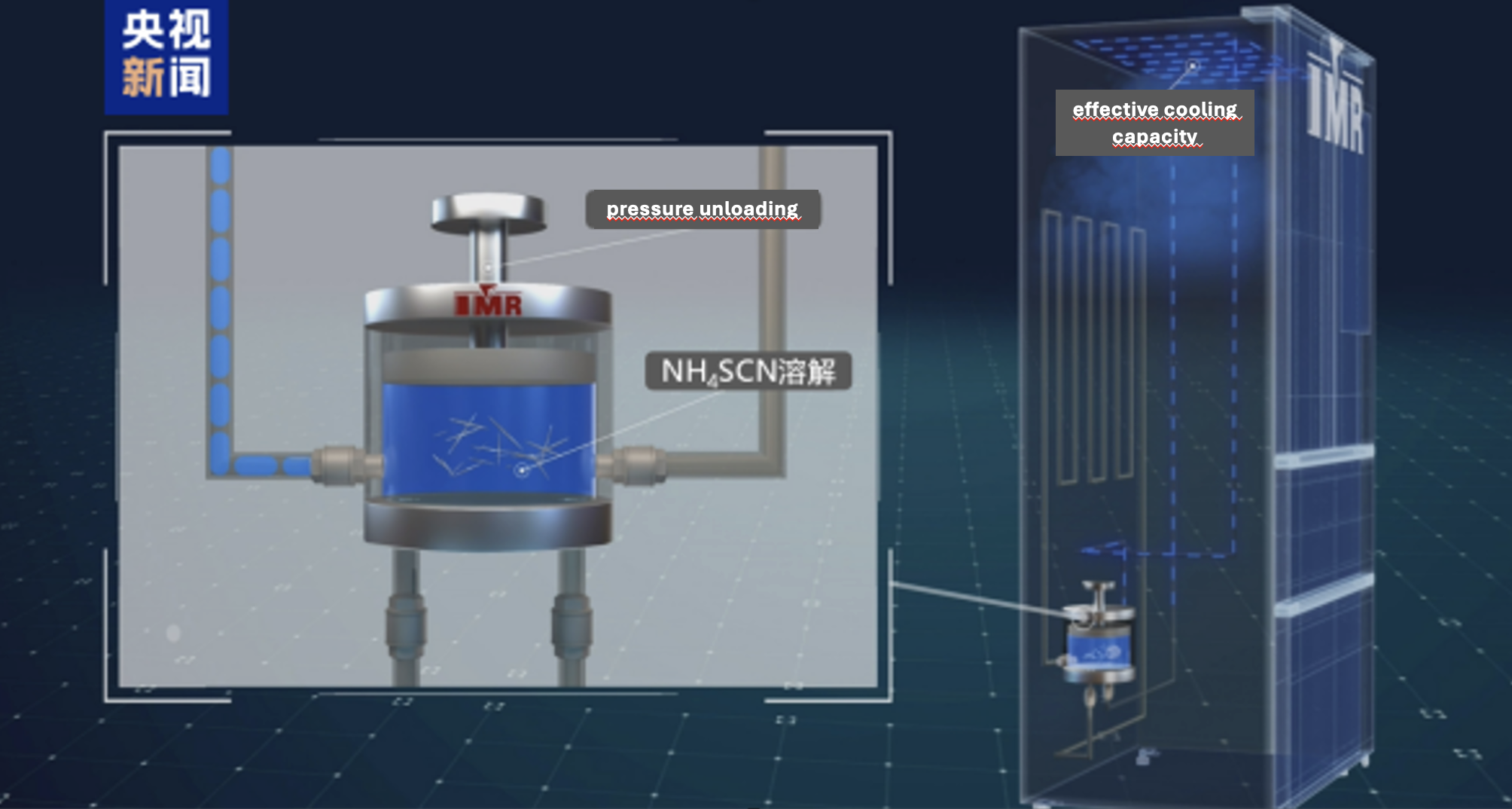
As a potential new concept, the group of LI Bing at the CAS Institute of Metal Research discovered the dissolution barocaloric effect in an NH4 SCN salt solution. When pressure is applied to such a solution, solid NH SCN precipitates and releases heat. In the event of depressurization, the salt rapidly dissolves in the solution while absorbing a large amount of heat. At room temperature, the solution’s temperature can drop by nearly 30 degrees Celsius within 20 seconds, with even greater cooling performance achieved at higher temperatures, far surpassing the capabilities of current solid-state caloric materials. Simulations showed that a single cycle of this system can achieve 67 joules of heat absorption per gram of solution, with an energy efficiency as high as 77 percent, demonstrating significant potential for engineering and commercial applications.
This new method unifies the refrigerant and heat-transfer mediums into a single fluid, achieving low carbon emissions, high cooling capacity and high heat transfer efficiency all at once.