https://www.cell.com/cell-stem-cell/fulltext/S1934-5909(25)00455-2
https://www.cas.cn/syky/202601/t20260119_5096513.shtml
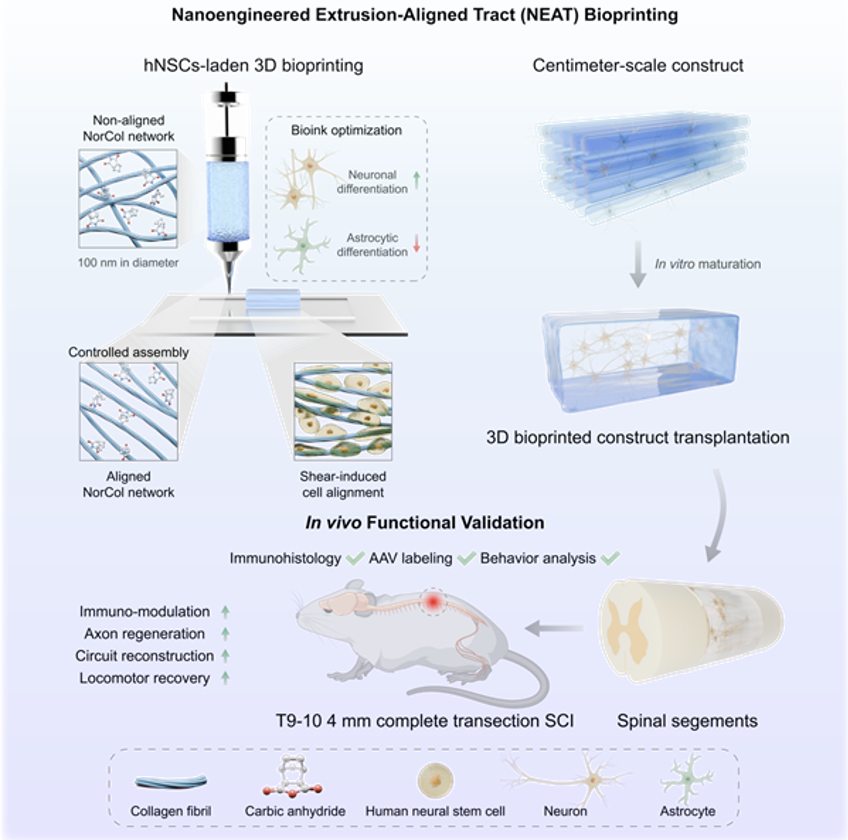
A core challenge in the field of biomanufacturing and tissue engineering is achieving stable and controllable spatial orientation structures in ultra-soft, high-water-content three-dimensional material systems. A research team from the CAS Institute of Zoology has proposed and verified a new bio-3D printing strategy to solve this issue.
In their NEAT bioprinting strategy, the material hierarchical assembly process is directly embedded into the printing manufacturing process itself. While preserving the triple helix structure and natural bioactivity of type I collagen, rapid photocrosslinking capability is introduced through norbornene chemical modification. Subsequently, a controllable shear stress field formed within the extrusion printing nozzle induces directional rearrangement and hierarchical assembly of collagen fibers during material deposition. The research team achieved the directional alignment of collagen nanofibers at the 50nm–200nm scale, the continuous assembly of micron-scale fiber bundles, and the overall orientational consistency of centimeter-scale three-dimensional structures.
The oriented structures constructed using the NEAT strategy provided a highly biomimetic physical microenvironment for human neural stem cells. The printed neural tissue exhibited stronger network synchronous oscillation activity, higher spontaneous neuronal firing frequency, and a larger voltage-gated sodium current peak, showing more mature and stable neural network functional characteristics overall. In further in vivo proof-of-concept studies, the research team transplanted the oriented structures constructed using NEAT into a rat model of complete transverse spinal cord injury at the T9-T10 segment. Results showed that, under complex physiological and mechanical conditions, inflammatory responses, and tissue remodeling, the oriented printed structures maintained their spatial orientation characteristics for a long period and served as stable physical templates for tissue reconstruction.