https://www.cas.cn/syky/202511/t20251121_5089533.shtml
https://academic.oup.com/nsr/advance-article/doi/10.1093/nsr/nwaf503/8323153
A research team at the CAS Tianjin Institute of Industrial Biotechnology has made progress in the field of cellulose-to-starch conversion.
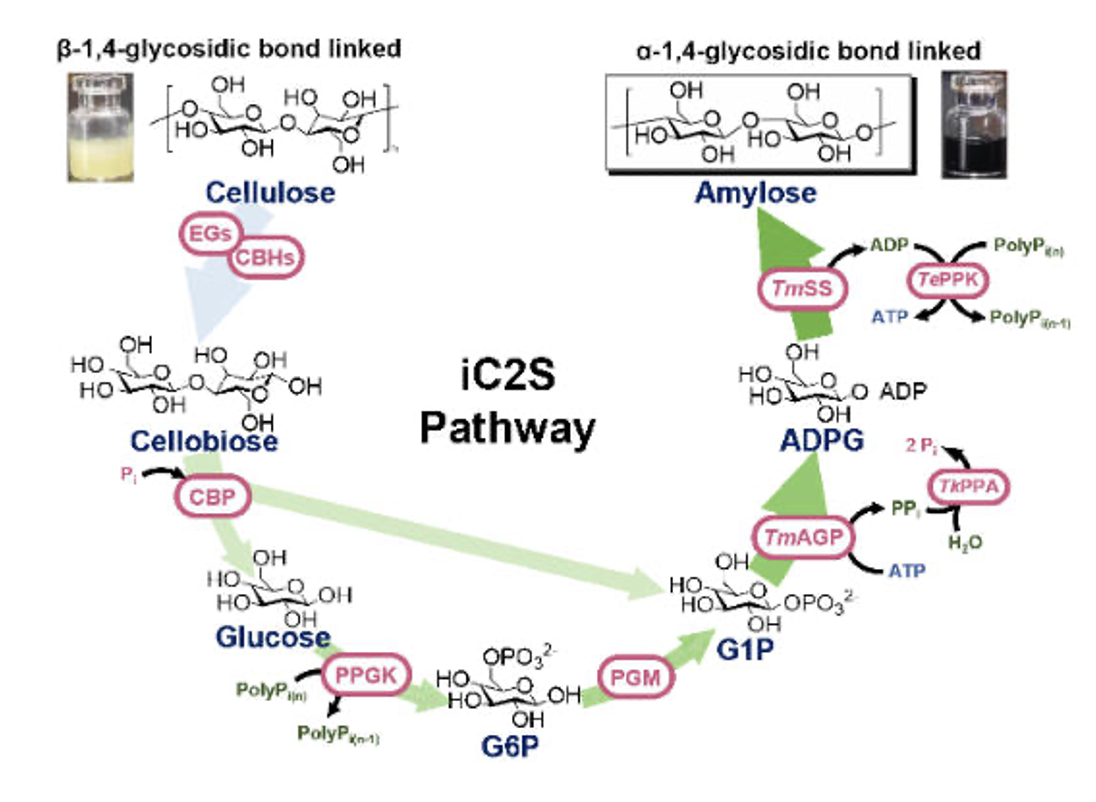
In recent years, through a multi-enzyme cascade strategy of “partial hydrolysis of cellulose—phospholysis of cellobiose—glucose polymerization to starch,” in vitro biotransformation technology has been able to partially convert cellulose into starch. However, limited by the synthetic route, the theoretical yield is only 50%, and it requires the assistance of microbial fermentation, resulting in an even lower actual yield, making it difficult to meet industrial needs.
The Tianjin team has reconstructed a new energy cycle pathway. Through design of a glucose recovery and activation reuse mechanism, they have increased the theoretical starch yield from 50% to 100%, fundamentally solving the carbon loss problem. Simultaneously, the team innovated the stability of enzyme elements, systematically mining and screening a series of novel enzyme elements with excellent thermal stability from special environments. This raised the overall reaction temperature to 50℃, significantly enhancing enzyme activity and reaction rate while drastically reducing the amount of enzyme required per unit output, laying a solid foundation for industrial scale-up. The team also optimized system integration, achieving a true conversion rate of cellulose to starch of 93.3% through synergistic optimization of various factors in the reaction system.
The starch produced by this technology is pure amylose with highly controllable degree of polymerization, extremely narrow molecular weight distribution (dispersion), and superior structural uniformity compared to naturally extracted starch. Currently, it has been successfully applied to chiral separation packing materials for the efficient separation of chiral drug molecules such as thalidomide.