https://pubs.acs.org/doi/10.1021/acs.nanolett.5c00378
https://en.people.cn/n3/2025/0513/c90000-20314300.html
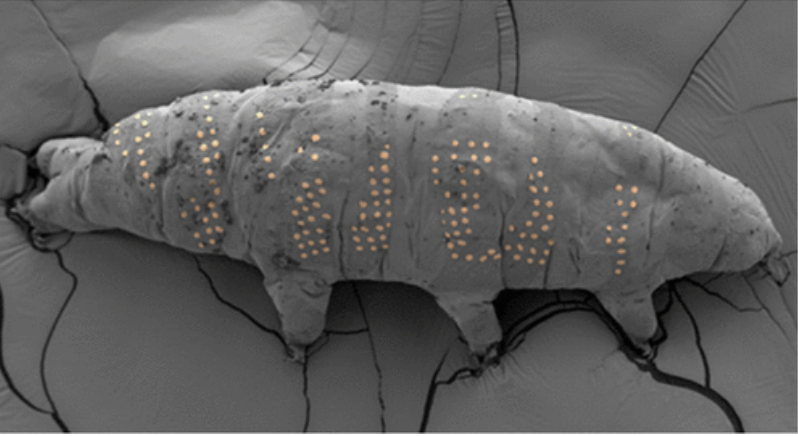
Researchers from Hangzhou’s Westlake University have developed ice-carving technology to create precise nanoscale patterns on tardigrades. The microscopic “tattoos” demonstrate ultra-high precision and excellent biocompatibility and could replace conventional photoresist materials. The electron beam etches patterns directly into the ice layer, avoiding contamination from resist removal and making biological applications possible. The ice can be either frozen water or frozen organic compounds.
Tardigrades are tiny creatures under 1 millimeter in length known as “water bears” which show extreme durability. They can survive extreme temperatures, dehydration, radiation, and toxic environments.
In an experiment, the researchers first put the tardigrades into a cryptobiotic state in which their metabolisms nearly stopped. They then coated them with a special nanoscale organic ice film. Following electron beam exposure, the ice formed stable, solid patterns on the tardigrades at room temperature. The “tattoos” remained intact even when stretched, soaked in solvents or dried.
The researcher expect to advance microbial sensors, bio-inspired devices and living microrobots by applying ice-carving technology to bacteria and viruses, combining living and mechanical systems to enhance performance.